Playbook
n8n vs Make vs Zapier in 2026: the complete decision guide
Zenith Automate | May 6, 2026 · 12 min read
A deep, hands-on comparison of the three dominant no-code automation platforms in 2026. Pricing models and cost at scale, hosting and data residency, error handling, the complexity ceiling, code steps, a decision framework, migration notes, and exactly when to leave no-code behind.
If you want to connect your tools and remove manual work, three platforms dominate the conversation in 2026: Zapier, Make, and n8n. They all promise the same headline outcome, "automate your work without code", but underneath they make very different trade-offs in pricing, power, hosting, and where they break. Pick the wrong one and you either overpay as you scale, hit a wall halfway through a build, or end up maintaining a tangle nobody understands.
I build production automations on all three, and the honest answer to "which is best?" is "it depends on the job." This guide gives you the framework I actually use, with enough depth to make the call yourself.
Key takeaways
- Zapier optimises for simplicity and the widest app catalogue. Best for linear, lower-volume flows the whole team can build and read.
- Make optimises for visual power and value. Best when flows branch, loop, and transform data, at a friendlier price than Zapier.
- n8n optimises for control. Self-hostable, code-friendly, predictable cost at scale. Best for complex or high-volume automation, and when data must stay on your infrastructure.
- The right choice often isn't a single platform. A no-code flow that calls one custom-code step beats torturing any tool past its ceiling.
The one-minute version
| Zapier | Make | n8n | |
|---|---|---|---|
| Best for | Simple, linear flows | Visual, branching flows | Complex / high-volume |
| Pricing model | Per task | Per operation | Per execution (or self-host) |
| Cost at scale | Gets expensive fast | Moderate | Lowest (self-host) |
| Hosting | Cloud only | Cloud only | Cloud or self-host |
| Data residency | Their cloud | Their cloud | Your infrastructure |
| Learning curve | Easiest | Moderate | Steepest |
| Complexity ceiling | Low | High | Highest |
| Branching & loops | Limited | First-class | First-class |
| Custom code | Limited | Good | First-class |
| Error handling | Basic | Good | Granular |
Now the nuance, because the table hides where each one actually hurts.
Zapier: simplest, widest, most expensive at scale
Zapier's superpower is approachability and its enormous app directory. If the task is "when a form is submitted, add a row to a sheet, post to Slack, and send a welcome email," Zapier is done in an afternoon and anyone on the team can read and edit it afterwards. That accessibility is genuinely valuable and easy to underrate.
Where it bites is twofold. First, pricing is per task, and a "task" is every single action a Zap performs. A flow with five steps that runs a thousand times a month is five thousand tasks, and that meter climbs quickly as you succeed. Second, the builder is fundamentally linear. Real branching, looping over lists, and reshaping data are awkward or require paid tiers and add-ons, so anything beyond a straight line starts to fight you.
Zapier is the right tool right up until your flow stops being a straight line, or until volume turns the per-task meter into a real bill.
Make: visual power at a friendlier price
Make (formerly Integromat) gives you a visual canvas where branching, iteration, and data transformation are first-class citizens. You can map data between modules, loop over arrays, route based on conditions, and handle errors per module. For the same money, you can usually accomplish more than in Zapier, and the per-operation model tends to be kinder to growing flows than per-task billing.
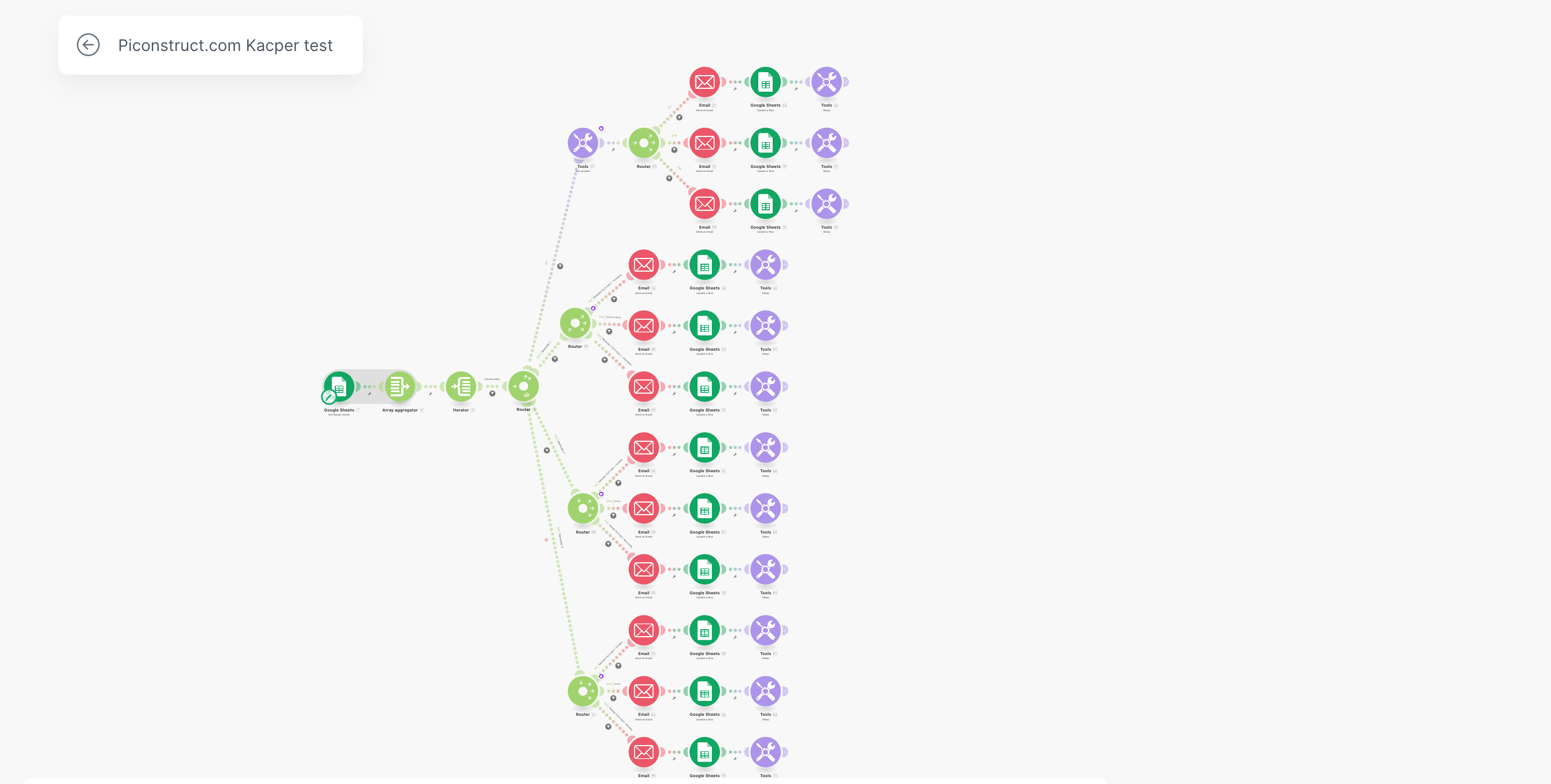
The trade-offs are real, though. The learning curve is steeper, because the power means more concepts to hold in your head. And that same flexibility lets you build a sixty-module scenario that only its author understands, a visual equivalent of spaghetti code. Power without discipline is just a more colourful kind of mess.
Make is the sweet spot for a large share of serious automation: more headroom than Zapier, far less operational burden than self-hosting n8n.
n8n: control, code, and predictable cost
n8n is the one I reach for when an automation needs to scale, get genuinely complex, or keep data on the client's own infrastructure. Three things set it apart:
- It is self-hostable. Run it on your own server and your data never leaves your control, which matters enormously for regulated industries and sensitive data. Cost becomes predictable infrastructure spend instead of a per-task meter that punishes growth.
- Code is first-class. Dropping into JavaScript or Python is a normal part of building, not a bolted-on escape hatch. The wall between no-code and code is low and you can cross it mid-flow.
- Error handling is granular. Dedicated error workflows, retries, and fine control over what happens when a step fails make it suitable for things you cannot afford to have silently break.
The cost is responsibility. Self-hosting means something to run, secure, and update. The learning curve is the steepest of the three. For a simple three-step flow, n8n is overkill. For a system that runs tens of thousands of times a day and needs custom logic, it is often the only one of the three that stays sane and affordable.
Cost at scale: the factor that ambushes people
The cheapest platform at ten runs a month is rarely the cheapest at a hundred thousand. Per-task and per-operation pricing are gentle at the start and steep at the top, while self-hosting flips the curve: a fixed infrastructure cost that barely moves as volume climbs.
The practical lesson: choose for where you are going, not just where you are. A flow that will run constantly should weigh cost-at-scale heavily. A flow that runs a few times a day can ignore it and optimise for simplicity.
How far each one stretches before it fights you
A decision framework you can actually use
Strip away the brand loyalty and the choice comes down to a short series of questions, in order.
- 1
Is the logic basically a straight line, and does every app have a ready connector?
Then Zapier or Make. Pick Zapier for the gentlest learning curve and the widest app catalogue; pick Make if you want more headroom for the same spend.
- 2
Does the flow branch, loop, or reshape data a lot?
Then Make, or n8n if it is also high-volume. This is where Zapier starts to hurt and Make starts to shine.
- 3
Is volume high, is cost a concern, or must data stay on your own infrastructure?
Then n8n, self-hosted. The fixed-cost curve and data residency are decisive once any of these is true.
- 4
Does one step need something no block can do?
Then any of them, with that one step written in real code. The platform orchestrates; the code handles the hard part.
The best code is no code at all.
That quote is the whole philosophy here. No-code is not a compromise or a lesser option, it is the right tool for a huge share of automation, and reaching for a custom build when a flow would do is its own kind of over-engineering.
When to leave no-code entirely
No-code platforms are excellent until the moment you start fighting them. The warning signs are consistent: a login or anti-bot wall, a system with no connector and only a raw API, heavy parsing or reconciliation, real scale, or a flow that has grown into an unmaintainable sprawl. Hit two or three of those and custom code is usually cheaper over the life of the project, even though it is slower to start.
I wrote a whole piece on exactly where that line sits in no-code or custom code: how to decide which way to automate. The short version: start no-code, and the first time the tool makes a simple thing genuinely hard, drop to code for that one step rather than fighting the platform.
A note on migration
People worry about getting locked in, and it is a fair concern. In practice, simple flows are easy to rebuild on a different platform because the logic is simple; complex flows are harder, but a complex flow is also a sign you may have outgrown a pure no-code approach. n8n's self-hosting gives you the most control and the least lock-in, which is part of why it is my default for anything strategic. If portability matters to you, factor it into the choice from the start rather than discovering it later.
Common automation recipes, and which platform fits
Theory only goes so far. Here are real, frequently-requested automations and where each one belongs, which is often more useful than the abstract comparison.
- Form to CRM to Slack to email. A lead fills a form; create a CRM record, notify a salesperson in Slack, send a tailored welcome email. Linear, every app has a connector, the team will want to tweak the copy. Zapier or Make. Reaching for n8n here is overkill.
- Sync two databases two ways. Keep records in two systems in step, handling conflicts and deletions. Branching, error handling, and volume make this Make or n8n, leaning n8n if the volume is high or the data is sensitive.
- Daily report pulled from several sources. Gather numbers from a few APIs, combine them, format a summary, and post it. The orchestration is no-code; if any source needs scraping or heavy transformation, that one step becomes a custom service the flow calls (a hybrid).
- Process incoming documents. Parse invoices or statements, extract fields, route by content. The parsing is beyond a block, so custom code does the extraction and a no-code flow handles the routing and notifications.
- High-frequency event processing. Thousands of webhook events an hour, transformed and stored. Per-task pricing makes Zapier painful here; self-hosted n8n keeps the cost flat and the throughput high.
The pattern across all of these: the simpler and more linear the job, the more Zapier and Make win on speed and readability; the more complex, high-volume, or sensitive, the more n8n (or a hybrid with custom code) wins on power and cost.
Security, compliance, and where your data lives
For many businesses this is the quiet deciding factor, and it gets overlooked until late. With Zapier and Make, your data passes through and is processed on their cloud infrastructure. For most use cases that is perfectly fine. For regulated industries, personal or financial data, or anything with strict residency requirements, it can be a hard blocker.
n8n's self-hosting is the answer when data cannot leave your control: you run it on your own server, in your own region, and nothing transits a third-party SaaS. That single capability is why n8n keeps winning enterprise and regulated work even when a cloud platform would be simpler to operate. If your data has compliance constraints, decide this first, because it can rule out two of the three options before you compare anything else.
It is also worth thinking about credentials. Every automation platform stores access to your other tools, so it becomes a sensitive piece of infrastructure in its own right. Self-hosting keeps those credentials on your side of the fence; cloud platforms keep them on theirs, protected by their security but outside your direct control. Neither is wrong, but it is a choice worth making consciously.
Frequently asked questions
The bottom line
There is no universally best platform, only the best fit for a specific job. Zapier for simple and broad, Make for visual and flexible, n8n for complex, high-volume, and data-sensitive, and real code for the parts none of them should be doing. The skill is not loyalty to one tool, it is knowing exactly where each one's wall is and stepping over it deliberately.
If you are not sure which side of that line your project sits on, that is precisely what a short audit answers fast. See the process automation and custom automation services, understand the pricing model, browse real builds, or tell me what you want to automate.
Have a process worth automating?
Tell me about it, I’ll reply within 24 hours.